My research interests are broadly motivated by the question “How did the Solar System form?” Planetary science is an inherently cross disciplinary field. So, I utilize techniques pulled from astronomy and geology to study the surfaces of objects within our Solar System.
Trojan Asteroids and the Lucy Mission
Jupiter Trojan asteroids (hereafter, Trojans) are an important population of asteroids that orbit in Jupiter’s stable Lagrange points. Trojans are particularly important because they link together formation theories and dynamical models that explain how our Solar System formed.
NASA’s Lucy mission is the first spacecraft designed to visit the Trojans. Lucy launched in 2021 and will do five Trojan encounters over a 12-year journey. So far Lucy has completed two ‘test’ encounters of main belt asteroids Dinkinesh in 2023, and DonaldJohanson in 2025. In 2027 Lucy will encounter its first Trojan target, Eurybates. I am a collaborator on the Lucy team. As a collaborator, and in my independent research, I look at the spectra of Trojan asteroids, like the Lucy Targets.
Follow along as Lucy journeys out to the Trojans! WhereIsLucy.Space
-
Relevant Papers
- The Discovery of a Contact-Binary Satellite of the Asteroid (152830) Dinkinesh by the Lucy Mission
- JWST near-infrared spectroscopy of the Lucy Jupiter Trojan flyby targets: Evidence for OH absorption, aliphatic organics, and CO2
- Surface Compositions of Trojan Asteroids
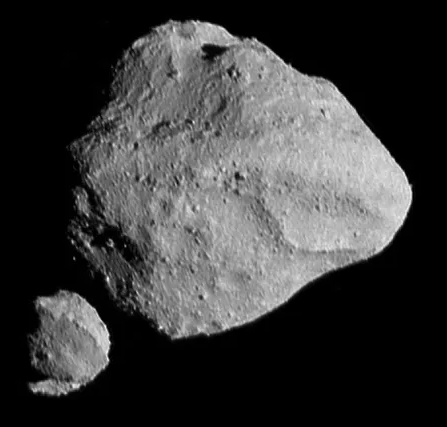
Asteroid Dinkinesh with its satellite, Selam. Credit: NASA/SwRI/JHPL/NOIRLab/Brian May
Lucy Mission Patch. Credit: NASA/SwRI
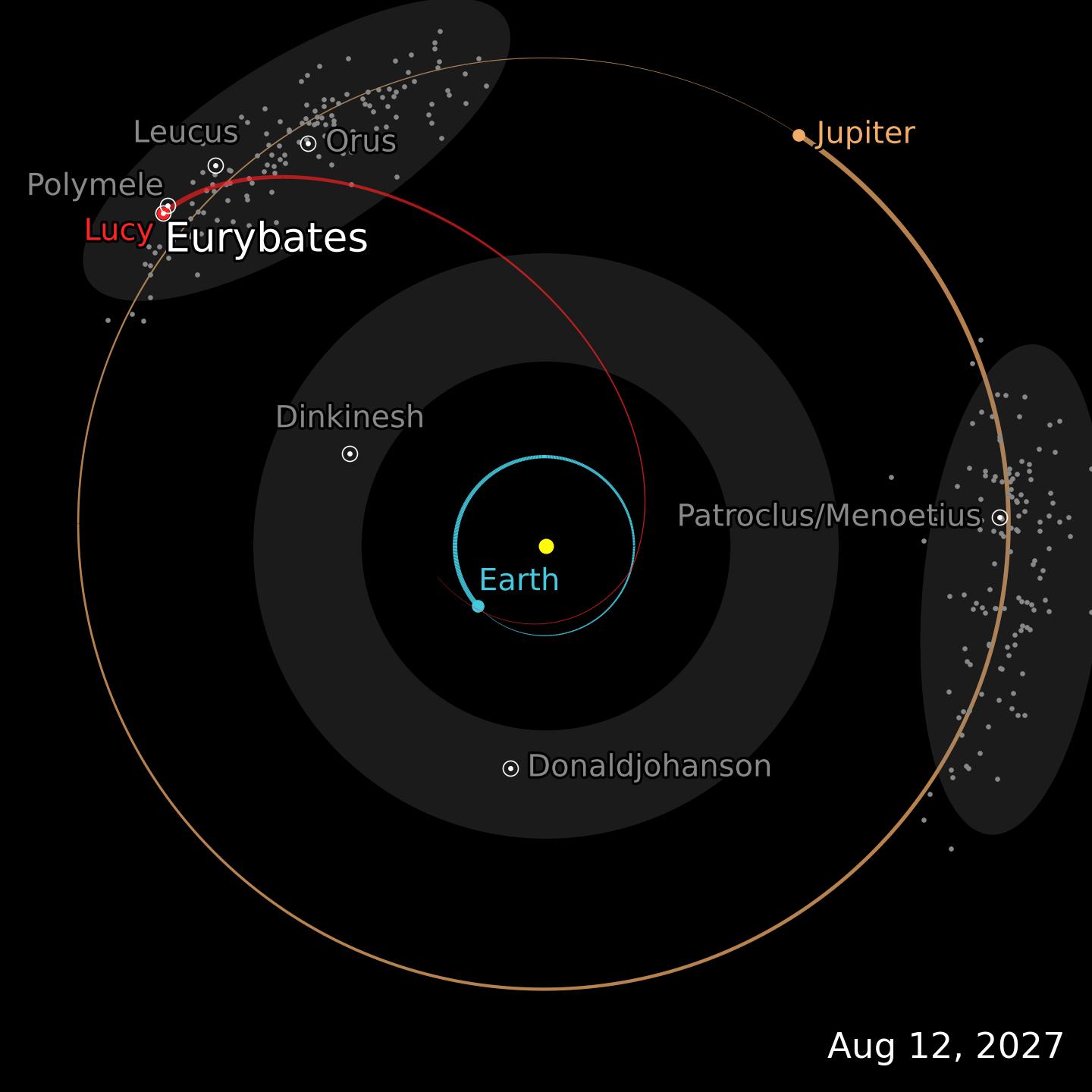
Solar System schematic with Lucy’s trajectory during the Eurybates encounter. Credit: NASA/Goddard/SwRI/ASU
Asteroid Spectroscopy
Asteroid have long been studied via spectroscopy. Historically, most observations focused on visible and near-infrared (VNIR) wavelengths. Recently, an increasing number of mid-infrared (MIR) observations have expanded our understanding of asteroids and their regoliths because MIR spectra are uniquely powerful for investigating silicate minerals and regolith structure (See Laboratory Spectroscopy below).
My research focuses on determining the composition and regolith properties of asteroids throughout the Solar System. Many asteroids, like the Trojans, exhibit few or no diagnostic features in the VNIR. Yet, these same objects display amazing spectral features in the MIR. By analyzing MIR spectra from the Spitzer Space Telescope archive and new spectra using James Webb Space Telescope, I can uncover the composition of otherwise featureless asteroids.
-
Relevant Papers
- Comparative Mid-Infrared Spectroscopy of Dark, Primitive Asteroids: Does Shared Taxonomic Cass Indicate Shared Silicate Composition?
- Mid-Infrared Spectral Analysis of Jovian Trojan Asteroids
Laboratory Spectroscopy
A central theme of my research is understanding how ‘regolith porosity’ (i.e., fluffy-ness) affects spectral signaturesin the mid-infrared wavelength region. To improve the interpretation of observations of rocky objects, like asteroids, I develop detailed spectral libraries of common asteroid minerals. By comparing these spectral libraries to asteroid spectra, we discovered that many asteroids have exceedingly fluffy regoliths. With a clearer picture of how porosity shapes spectral behavior, more reliable compositional interpretations become possible. These spectral libraries are freely available via the links below.
This work is ongoing! I am actively developing and publishing additional spectral libraries to meet the growing need for high-quality, well-characterized analog spectra.
-
Relevant Papers
- Mid-Infrared Reflectance and Emissivity Spectra of High Porosity Regoliths
Data Available Here - Measuring the effects of regolith porosity on mid-IR spectra of the Allende meteorite
Data Available Here - Spectral effect of regolith porosity in the Mid-IR – Pyroxene
Data Available Here - Spectral effect of regolith porosity in the Mid-IR – Forsteritic olivine
Data Available Here
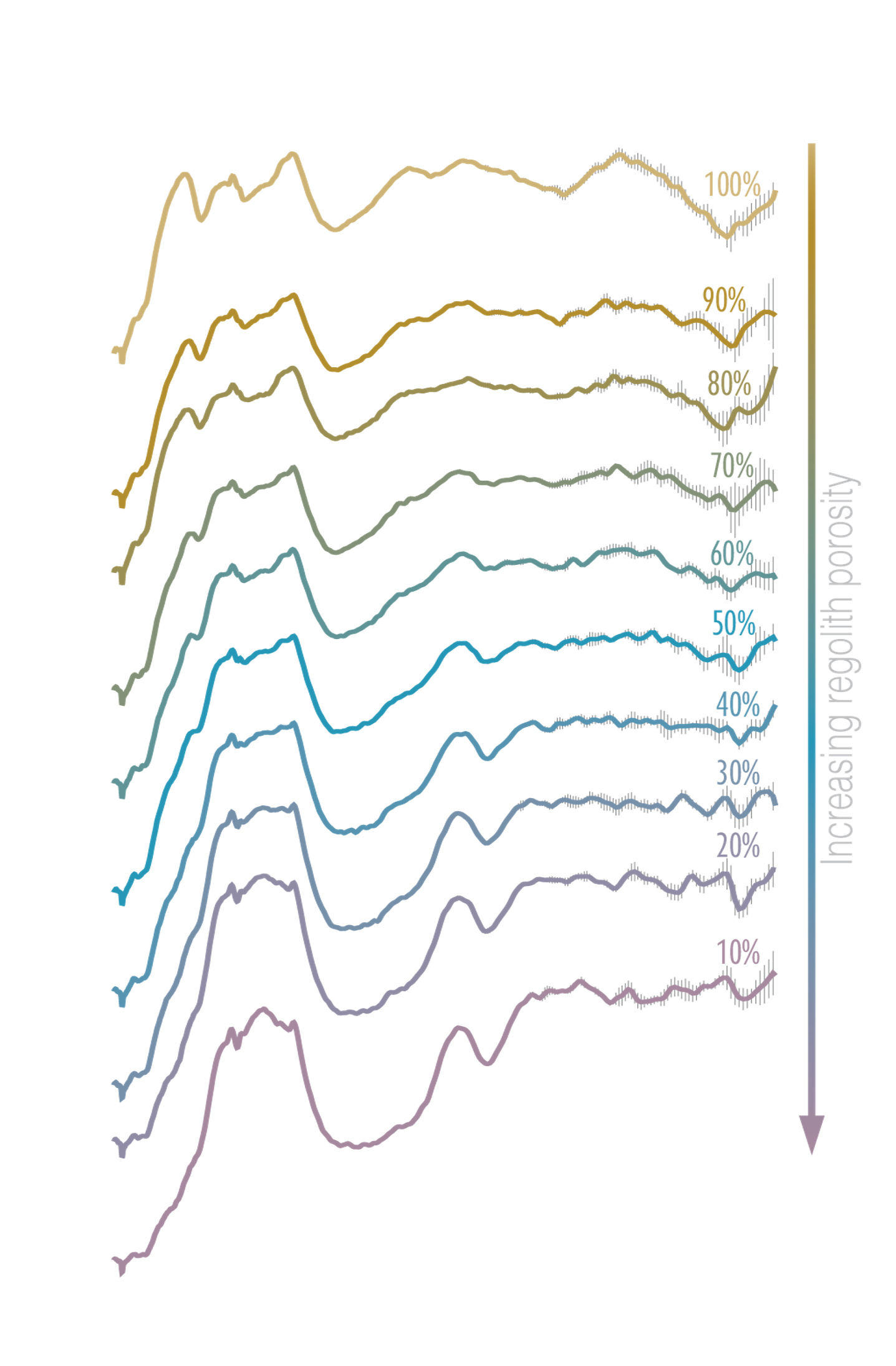
Spectra of particulate olivine with increasing regolith porosity from top to bottom (Martin et al., 2022).
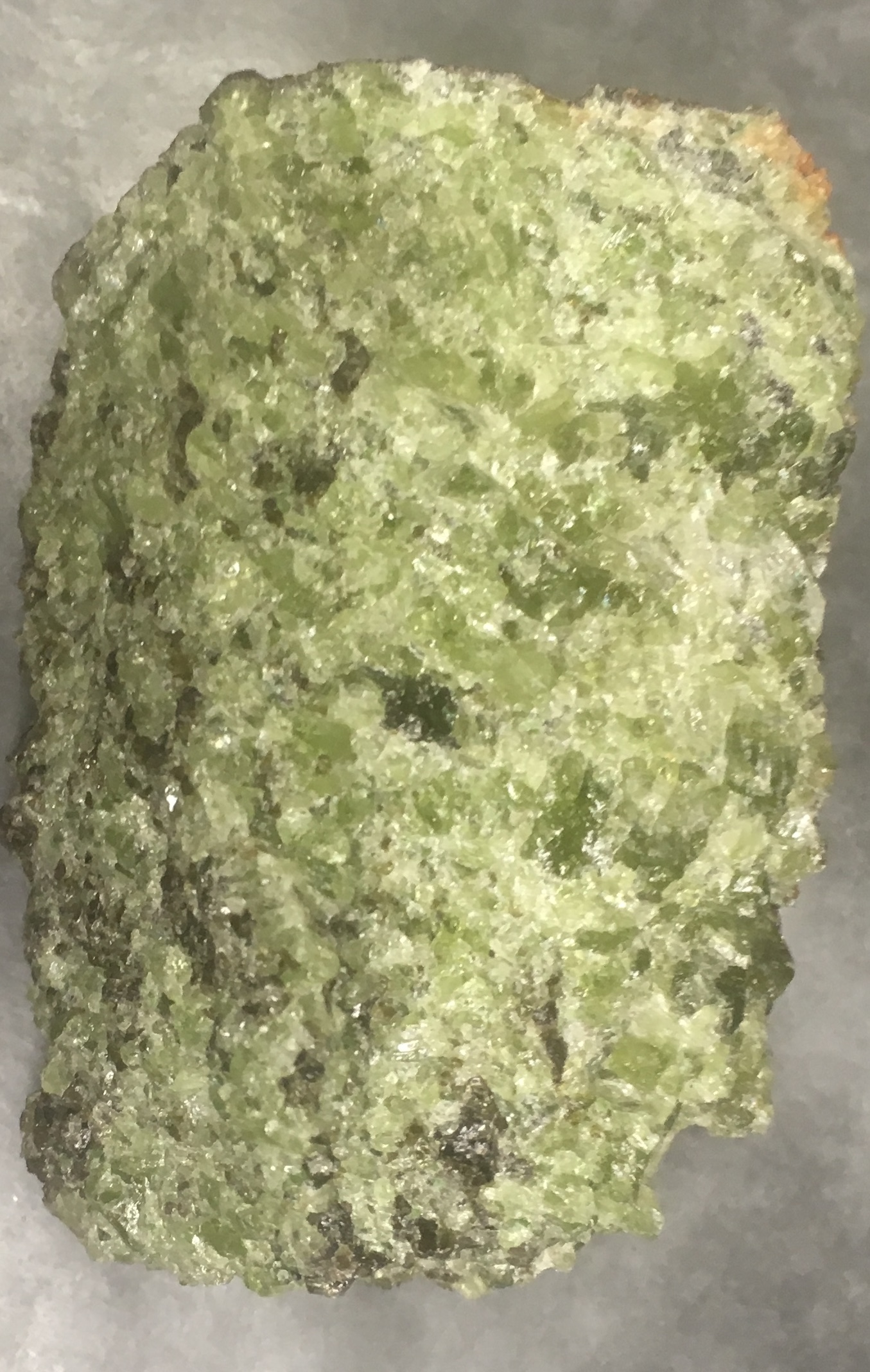
Olivine hand sample.
Analog Field Work
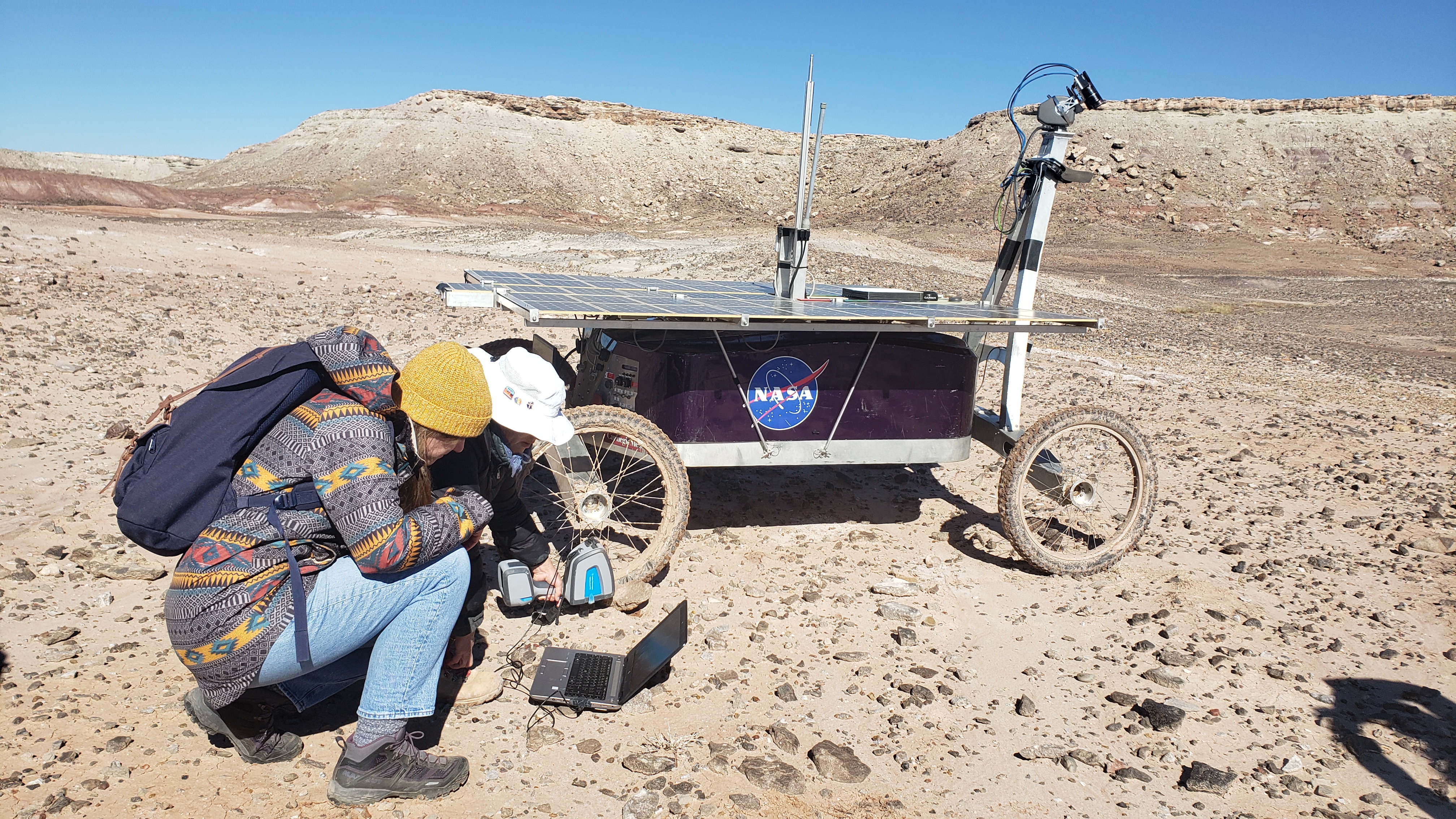
I have had the opportunity to participate in a few field campaigns including an active neutron detector test at Goddard Space Flight Center, and a rover autonomy experiment with the Planetary Science Institute’s SSERVI team.
-
Relevant Papers
- Rover Science Autonomy in Planetary Exploration: Field Analog Tests
- Active neutron interrogation experiments and simulation verification using the SIngle-scintillator Neutron and Gamma-Ray spectrometer (SINGR) for geosciences.